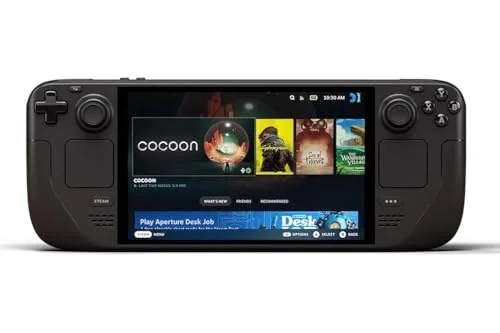
Valve more or less created the modern PC handheld category with the original Steam Deck, and the OLED revision is the version that fixes almost every complaint about the first model. At around £569 it pairs a stunning HDR OLED panel with a larger battery, faster WiFi, a lighter chassis and quieter cooling, all running SteamOS, which remains the most thoughtfully designed handheld interface anyone has shipped. That blend of screen, stamina and software is exactly what makes it our best overall pick, even though it is not the most powerful chip you can buy.
Steam Deck OLED: full specifications | Display | 7.4 in OLED, 1280 x 800, 90 Hz, HDR |
|---|
| Chip | Custom AMD APU (Zen 2 CPU / RDNA 2 GPU) |
|---|
| Battery | 50 Wh |
|---|
| Storage | 1 TB NVMe SSD + microSD |
|---|
| Weight | 640 g |
|---|
| Operating system | SteamOS 3 (Linux) |
|---|
| Measured frame rate (Cyberpunk 2077, low + FSR) | 46 fps |
|---|
| Measured battery (same test) | 3 h 50 min |
|---|
| Connectivity | WiFi 6E, Bluetooth 5.3, USB-C |
|---|
| Typical UK price | £569.00 |
|---|
Who is the Steam Deck OLED for?
The Steam Deck OLED is the right console if you want one device that plays your entire Steam library, is genuinely easy to live with, and lasts long enough to be worth carrying. SteamOS suspends and resumes a game in a second, so you can dip in and out the way you would on a Switch, and its console-style menu means you rarely touch a desktop. For the player who has a big PC library, or who is buying their first PC handheld and wants the least friction, it is the obvious choice.
It is less suited to two groups. Players who must have the absolute highest frame rate, or who rely on a Windows-only launcher or anti-cheat game, are better served by the ROG Ally X or another Windows handheld. And anyone whose wishlist is mostly Nintendo titles needs the Switch OLED instead, because the Deck cannot play them. For the broad middle of buyers, though, the Steam Deck OLED is the one we reach for first, and our Steam Deck vs ROG Ally guide digs into that choice in depth.
How the Steam Deck OLED performs
Frame rate and the screen
In our standard Cyberpunk 2077 run at low settings with FSR, the Steam Deck OLED held a steady 46 fps while drawing a modest 12 W, the best efficiency of any console on test. That is not the highest number here, the ROG Ally X reached 58 fps, but it is more than enough for the vast majority of games, and the steadiness matters more than the peak. The real star is the screen: a 7.4 in 90 Hz HDR OLED panel that makes 2D games, indies and anything colourful look genuinely beautiful, with deep blacks an LCD simply cannot match. It is the best handheld display here for the money.
Battery life
This is where the Deck pulls ahead. In the same heavy Cyberpunk test it lasted 3 hours 50 minutes, the longest of any PC handheld on this list, thanks to the efficient chip and the 50 Wh battery. With lighter 2D and indie games, a capped frame rate and the brightness down, we comfortably saw 7 to 8 hours. For long sessions away from a socket, on a flight, a commute or in bed, it is the most dependable powerful handheld you can buy.
Software and ergonomics
SteamOS is the quiet reason the Deck stays our favourite. It is fast, stable and built for the device, with per-game performance settings, an instant suspend that just works, and a layout you never need a mouse for. The hardware backs it up: rear grips that fit the hand, two trackpads that make strategy and desktop games properly playable, and Hall-effect-free but reliable sticks. At 640 g it is the heaviest device here, which is the one ergonomic compromise, but the balance is good enough that it rarely feels it.
The honest downsides
There are two worth weighing. First, it runs SteamOS, not Windows, so while Proton runs the overwhelming majority of Steam games with no setup, a small number of titles with aggressive anti-cheat will not run at all, and a few non-Steam launchers need a workaround. If you live in those specific games, check compatibility first. Second, at 640 g it is the heaviest console on test, noticeable over a long session. Neither is a flaw in what the Deck sets out to do; they are the trade-offs of its design, and for most players they are easy to accept.
The good
- Best handheld software on the market (SteamOS)
- Gorgeous 90 Hz HDR OLED screen
- Best battery life of any PC handheld here (3 h 50)
- Excellent value for the hardware at £569
- Trackpads make strategy and desktop games playable
The not-so-good
- SteamOS blocks a few anti-cheat games
- Heaviest device on test at 640 g
- Dock sold separately
- Not the highest peak frame rate here
Best for: almost anyone buying their first PC handheld, or any player who wants the easiest, most efficient way to play a big Steam library on the go. Not the pick if you need Windows-only games (try the ROG Ally X) or Nintendo exclusives (try the Switch OLED).