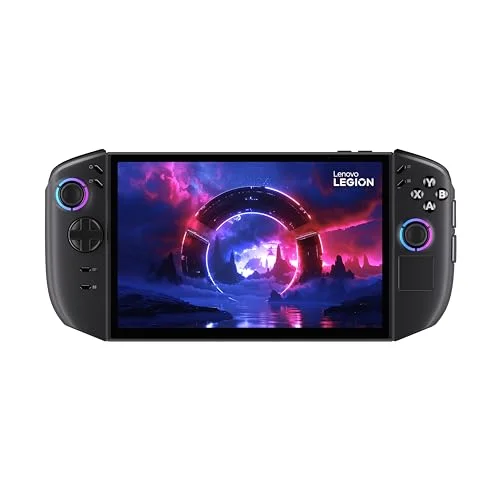
Lenovo Legion Go: full specifications | Display | 8.8 in IPS, 2560 x 1600, 144 Hz |
|---|
| Chip | AMD Ryzen Z1 Extreme |
|---|
| Battery | 49.2 Wh |
|---|
| Storage | 512 GB NVMe SSD + microSD |
|---|
| Weight | 854 g (with controllers) |
|---|
| Operating system | Windows 11 |
|---|
| Measured frame rate (Cyberpunk 2077, low + FSR) | 52 fps |
|---|
| Measured battery (same test) | 2 h 10 min |
|---|
| Special features | Detachable TrueStrike controllers, FPS mode, kickstand |
|---|
| Typical UK price | £699.99 |
|---|
Who is the Legion Go for?
The Legion Go is the right console if you value screen size and flexibility above weight and battery. The 8.8 in 1600p 144 Hz display is the biggest and sharpest on this list, and it makes detailed games genuinely immersive, especially with the kickstand out and the controllers detached on a table. For couch gaming, strategy games and anyone who plays mostly at home or near a charger, it is a compelling, distinctive device that no rival matches on screen.
It is less suited to commuters and anyone who plays in bed for hours. At 854 g with the controllers attached it is the heaviest device here by a wide margin, and the power-hungry screen gives it the shortest battery life on test. If portability and stamina are your priorities, the lighter Steam Deck OLED or the more efficient MSI Claw 8 are better choices. The Legion Go is a near-portable that doubles as a tiny PC, not a pocketable travel machine.
How the Legion Go performs
The screen and frame rate
The display is the whole reason to buy a Legion Go. At 8.8 in and 2560 x 1600 it is far larger and sharper than anything else here, with a 144 Hz refresh rate, and detailed games look superb on it. Driving games at that native 1600p resolution, though, hammers both the chip and the battery, so in practice most people run at 1080p, where it still looks excellent. At 1080p in our Cyberpunk run it returned 52 fps on the same Ryzen Z1 Extreme as the ROG Ally X, just behind it, which is strong performance.
Battery life
Battery is the Legion Go's clear weakness. The 49.2 Wh battery, smaller than the Ally X's 80 Wh, powers a large high-resolution screen, and under our heavy Cyberpunk load it lasted just 2 hours 10 minutes, the shortest on this list. Capping the frame rate, dropping to 1080p and lowering brightness all help considerably, and for less demanding games it stretches much further. But if all-day battery matters, this is not the handheld for you.
Controls and the FPS mode
The detachable TrueStrike controllers are a genuine highlight. They slide off the sides Switch-style for tabletop play, and the right controller stands upright on an included base to become a vertical mouse, the FPS mode, which really does help in shooters and strategy games once you adjust. Combined with the built-in kickstand, it makes the Legion Go the most flexible handheld here for how and where you play, even if some of those modes take practice.
The honest downsides
Two stand out. First, the weight: at 854 g it is tiring to hold like a traditional handheld for a long session, which undercuts its portability. Second, the battery life is the weakest here, a direct consequence of the big screen. Both are the price of the Legion Go's ambition, and neither is a fault so much as a trade-off. If the large screen and detachable controllers are what you want, you accept the weight and the charger; if they are not, a lighter handheld will suit you better.
The good
- Biggest, sharpest screen on test (8.8 in 1600p)
- Detachable controllers and FPS mouse mode
- Same fast Z1 Extreme chip (52 fps)
- Built-in kickstand for tabletop play
- Great for couch and strategy games
The not-so-good
- Heaviest device on test at 854 g
- Shortest battery life here (2 h 10)
- Windows is clunky on a handheld
- Native 1600p is hard to drive
Best for: the player who wants the biggest screen and the most flexible controls for home and couch gaming, and stays near a charger. Not the pick if you want light weight and long battery (try the Steam Deck OLED or MSI Claw 8).