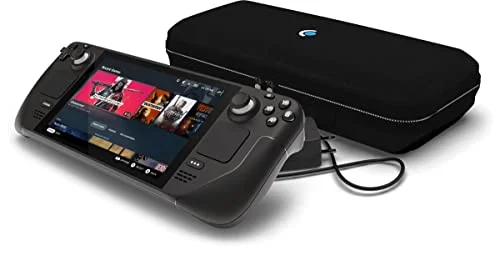
When the Steam Deck OLED arrived, the original LCD model did not disappear, it dropped in price and became the value entry point to PC handheld gaming. It runs the exact same SteamOS and the exact same chip as the OLED, so it plays your entire Steam library identically. What you give up is the OLED screen, some battery life and a few refinements, in exchange for a price that starts at £419 new and less refurbished. For anyone on a budget, it is the smartest way in.
Steam Deck LCD: full specifications | Display | 7 in IPS LCD, 1280 x 800, 60 Hz |
|---|
| Chip | Custom AMD APU (Zen 2 CPU / RDNA 2 GPU) |
|---|
| Battery | 40 Wh |
|---|
| Storage | 256 GB NVMe SSD + microSD |
|---|
| Weight | 669 g |
|---|
| Operating system | SteamOS 3 (Linux) |
|---|
| Measured frame rate (Cyberpunk 2077, low + FSR) | 44 fps |
|---|
| Measured battery (same test) | 2 h 50 min |
|---|
| Connectivity | WiFi 5, Bluetooth 5.0, USB-C |
|---|
| Typical UK price | £419.00 |
|---|
Who is the Steam Deck LCD for?
The LCD Steam Deck is the right console if you want real PC handheld gaming for as little as possible. It gives you the same SteamOS experience, the same game performance and the same access to your whole Steam library as the OLED, for around £150 less. For a first PC handheld on a budget, a second device to leave by the sofa, or anyone who would rather spend the saving on games and a microSD card, it is excellent value, and our best budget handheld console guide ranks it first for exactly that reason.
It is less suited to anyone who wants the best screen or the longest battery. The OLED model's panel and stamina are a clear step up, so if you can stretch to the Steam Deck OLED, you should. And like all the Decks, it cannot play Nintendo games, so if that is your library you need a Switch OLED instead. But purely as a value PC handheld, nothing here beats it on price for what you get.
How the Steam Deck LCD performs
Frame rate and the screen
Because it uses the same chip as the OLED, game performance is effectively identical: in our Cyberpunk 2077 run it returned 44 fps against the OLED's 46, a difference you cannot feel. The screen is where the saving shows. It is a 7 in 800p LCD at 60 Hz, perfectly sharp and bright enough indoors, but it lacks the deep blacks, vivid colour and 90 Hz smoothness of the OLED panel. Side by side the OLED clearly looks better; on its own, the LCD is still a good screen that does the job well.
Battery life
The LCD has a smaller 40 Wh battery against the OLED's 50 Wh, and an LCD panel that draws a little more power, so it lasts less time. In our heavy Cyberpunk test it managed 2 hours 50 minutes against the OLED's 3 hours 50. With lighter games and a capped frame rate it still stretches to 5 or 6 hours, which is plenty for most sessions, but battery is the clearest practical difference between the two Decks alongside the screen.
Software and upgradeability
SteamOS is identical to the OLED's, with the same instant suspend, clean menu and per-game settings, so the day-to-day experience is exactly as good. The LCD is also genuinely upgradeable: the SSD is a standard 2230 M.2 NVMe drive you can swap yourself with care, and like every Deck it takes a microSD card. Buying the cheapest 256 GB model and adding your own larger SSD or a fast card is a popular, cost-effective route to plenty of storage.
The honest downsides
Two, and both are the reasons the OLED exists. First, the LCD screen is a clear step below the OLED panel, with shallower blacks, less vivid colour and a 60 Hz rather than 90 Hz refresh. Second, the smaller battery means shorter sessions. Neither makes the LCD a poor device, it plays every game the OLED does, just as well, but if budget allows, the OLED is the better machine. The LCD's whole appeal is that it gives you almost all of the experience for noticeably less.
The good
- Cheapest route into a real PC handheld (£419)
- Same excellent SteamOS as the OLED
- Same game performance (44 fps)
- User-upgradeable SSD and microSD
- Strong refurbished value from Valve
The not-so-good
- LCD screen at 60 Hz, not OLED
- Shorter battery than the OLED (2 h 50)
- Slower WiFi 5 rather than 6E
- Cannot play Nintendo games
Best for: the budget-minded player who wants real PC handheld gaming and the brilliant SteamOS for as little as possible. Not the pick if you want the best screen and battery (stretch to the Steam Deck OLED) or Nintendo exclusives (try the Switch OLED).