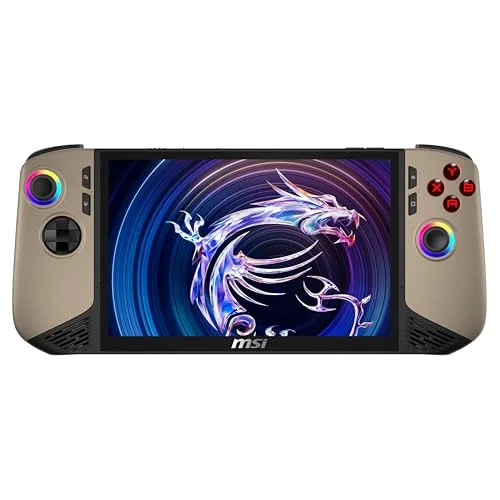
MSI's first Claw was a rough launch, but the Claw 8 AI+ is a genuinely strong device, and it does something no other Windows handheld here manages: it lasts. Built around Intel's new Lunar Lake chip, which is notably more efficient than the Ryzen Z1 Extreme, it delivers solid performance with the best battery life of any Windows device on test, on a large 8 in screen with drift-proof Hall-effect sticks. At £899.99 it is the most expensive handheld here, but for long sessions away from a charger it is the standout Windows option.
MSI Claw 8 AI+: full specifications | Display | 8 in IPS, 1920 x 1200, 120 Hz |
|---|
| Chip | Intel Core Ultra 7 258V (Lunar Lake) |
|---|
| Battery | 80 Wh |
|---|
| Storage | 1 TB NVMe SSD + microSD |
|---|
| Weight | 795 g |
|---|
| Operating system | Windows 11 |
|---|
| Measured frame rate (Cyberpunk 2077, low + FSR) | 49 fps |
|---|
| Measured battery (same test) | 3 h 5 min |
|---|
| Sticks | Hall-effect (drift-resistant) |
|---|
| Typical UK price | £899.99 |
|---|
Who is the MSI Claw 8 for?
The Claw 8 is the right console if you want a Windows handheld that lasts, with a big screen and long-term reliability. Its Lunar Lake chip sips power, so it outlasts every other Windows device here under load and barely loses charge in standby overnight, which Windows handhelds historically struggle with. The 8 in 1200p screen is generous, the Hall-effect sticks should never drift, and the build feels genuinely premium. For the player who games for long stretches on the move and wants Windows flexibility, it is the pick.
It is less suited to two groups. Anyone chasing the absolute highest frame rate will find the ROG Ally X faster and cheaper, and players who want the simplest, most efficient experience overall are better served by the Steam Deck OLED, which still beats it on both price and battery. The Claw 8 occupies a specific niche: the most efficient Windows handheld, at a premium price. Our SteamOS versus Windows guide helps frame that decision.
How the MSI Claw 8 performs
Frame rate and efficiency
In our Cyberpunk 2077 run the Claw 8 returned 49 fps, a touch behind the AMD handhelds but very playable, and it did so while drawing noticeably less power. That efficiency is the whole story: where the ROG Ally X trades higher frames for shorter battery, the Claw 8 holds a steady frame rate for longer. Intel's Arc graphics have improved a great deal, and most games now run well, though a handful still favour AMD and the occasional new release needs a driver update before it is smooth.
Battery life
This is where the Claw 8 wins among Windows handhelds. Under our heavy Cyberpunk load it lasted 3 hours 5 minutes, the best of any Windows device on test, and with lighter games or a capped frame rate we saw 5 to 6 hours. Just as important, its standby drain is unusually low, so left in sleep overnight it barely loses charge, something Windows handhelds are notorious for getting wrong. For travel and long sessions, that combination is genuinely valuable.
Screen, sticks and build
The 8 in 1920 x 1200 120 Hz screen is bright and roomy, sitting between the 7 in Ally X and the huge Legion Go. The Hall-effect thumbsticks use magnets rather than physical contacts, so they should never develop the stick drift that plagues many controllers, a real long-term reliability advantage. The build is solid and premium throughout, and at 795 g it is heavier than the Steam Deck but lighter than the Legion Go, sitting comfortably in the hand for most sessions.
The honest downsides
Two stand out. First, the price: at £899.99 it is the most expensive handheld here, a clear step above the faster ROG Ally X and far above the Steam Deck OLED. Second, Intel Arc drivers, while much improved, remain slightly less consistent than AMD's across a big library, so the odd game performs better on a rival or needs a patch first. Neither undermines a fundamentally excellent device, but they are why it is a considered pick rather than an obvious one.
The good
- Most efficient Windows handheld on test
- Best Windows battery here (3 h 5, low standby drain)
- Large 8 in 1200p 120 Hz screen
- Drift-proof Hall-effect sticks
- Premium, solid build quality
The not-so-good
- Most expensive handheld here at £899.99
- Intel Arc drivers trail AMD in a few games
- Slightly slower than the ROG Ally X
- Windows is still clunky on a handheld
Best for: the player who wants a Windows handheld with the longest battery and best reliability, and will pay for it. Not the pick if you want the most frames per pound (try the ROG Ally X) or the best value overall (try the Steam Deck OLED).