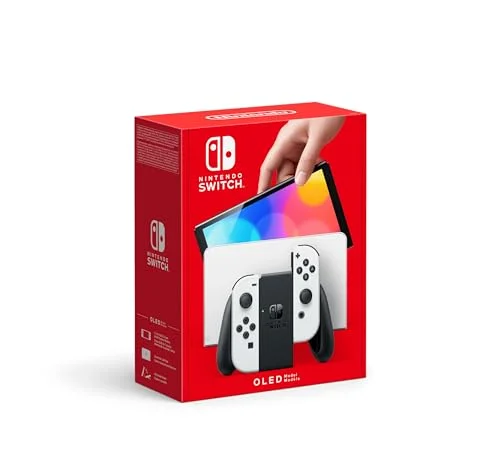
The Switch OLED is the most refined version of Nintendo's hybrid console, and it remains a genuinely easy recommendation for a specific buyer. Its hardware is far weaker than the PC handhelds on this list, but that misses the point: nobody buys a Switch to run Cyberpunk at 58 fps. They buy it for Zelda, Mario, Metroid and a deep library of first-party and indie games that exist nowhere else, on a console that weighs just 420 g and docks straight to the TV. At around £310 it does that beautifully.
Nintendo Switch OLED: full specifications | Display | 7 in OLED, 1280 x 720, 60 Hz |
|---|
| Chip | Nvidia Tegra X1 (custom) |
|---|
| Battery | 4310 mAh |
|---|
| Storage | 64 GB + microSD |
|---|
| Weight | 420 g (with Joy-Con) |
|---|
| Operating system | Nintendo Switch OS |
|---|
| Measured frame rate (Zelda: Tears of the Kingdom) | 30 fps (locked) |
|---|
| Measured battery (same test) | 5 h 20 min |
|---|
| Docked output | Up to 1080p / 60 Hz to a TV |
|---|
| Typical UK price | £309.99 |
|---|
Who is the Switch OLED for?
The Switch OLED is the right console if your wishlist is full of Nintendo games, or if you want a light, simple, family-friendly handheld that also plays on the TV. It is the only device on this list that plays Zelda, Mario Kart, Super Smash Bros. and the rest of Nintendo's catalogue, and at 420 g it is by far the easiest to hold for hours or hand to a child. The dock turns it into a living-room console with no extra kit, which none of the PC handhelds manage so cleanly out of the box.
It is less suited to anyone who wants to play modern PC games or push high frame rates. The Tegra X1 chip is years old and its games run at modest resolutions and a locked 30 or 60 fps, so if you want to play your Steam library or the latest demanding releases, you need a Steam Deck OLED or a Windows handheld instead. Many keen gamers end up owning both a Switch and a PC handheld, because they do different jobs. Our budget handheld guide compares it with the cheaper PC options.
How the Switch OLED performs
The screen and the upgrade
The OLED model's headline feature is its 7 in OLED screen, and it is lovely: vivid colours, true blacks and a noticeably larger, more immersive display than the original Switch's 6.2 in LCD. Performance is identical to the standard Switch because it uses the same chip, so this is a quality-of-life upgrade, not a power one. You also get double the storage at 64 GB, a far sturdier full-width kickstand and an improved dock with a wired LAN port. For handheld play, the screen alone justifies the OLED over the older models.
Battery life
Battery is a quiet strength. Running Zelda: Tears of the Kingdom, one of the most demanding Switch games, it lasted 5 hours 20 minutes in our test, the longest of any console on this list, because Switch games are far lighter than PC titles. Less demanding 2D and indie games comfortably run beyond that, often to 7 or 8 hours. For a handheld you actually carry and play in short bursts through the day, its stamina is excellent.
Software and reliability
The Switch interface is simple and quick, with none of the desktop awkwardness of a Windows handheld, and the hardware has a long, proven reliability record. Joy-Con drift remains the one well-known weakness, though Nintendo repairs it, and many players prefer a Pro Controller for docked play. As a pick-up-and-play machine that any member of the family can use, nothing here is more straightforward.
The honest downsides
There are two. First, the hardware is old and weak next to the PC handhelds, so the Switch is locked to its own ecosystem and cannot grow into modern PC gaming. Second, you are buying into a console that has been on sale for years, so if you want the latest hardware it may be worth watching for Nintendo's next system. Neither matters if you simply want to play Nintendo's games on a lovely screen today, which the Switch OLED does as well as it ever has.
The good
- Lightest mainstream handheld here at 420 g
- Only way to play Nintendo exclusives
- Lovely 7 in OLED screen
- Longest battery on test (5 h 20)
- Docks to the TV with no extra kit
The not-so-good
- Far weaker hardware than the PC handhelds
- Locked to the Nintendo eShop
- Joy-Con drift remains a known issue
- Ageing console late in its life
Best for: anyone whose wishlist is full of Nintendo games, or who wants a light, simple handheld that also plays on the TV. Not the pick if you want to play PC games or push high frame rates (try the Steam Deck OLED).