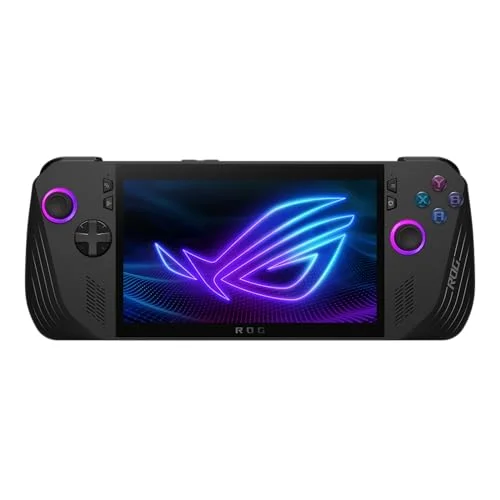
Asus learned a great deal from the first ROG Ally, and the Ally X is the result: same fast Ryzen Z1 Extreme chip, but with a much larger 80 Wh battery, better ergonomics, improved cooling and a redesigned SD card slot. At £799.99 it is the handheld to pick if you want the highest frame rate and the flexibility of full Windows, and you are willing to pay for both. It is not the easiest console to live with, but it is the most capable.
Asus ROG Ally X: full specifications | Display | 7 in IPS, 1920 x 1080, 120 Hz |
|---|
| Chip | AMD Ryzen Z1 Extreme |
|---|
| Battery | 80 Wh |
|---|
| Storage | 1 TB NVMe SSD + microSD |
|---|
| Weight | 678 g |
|---|
| Operating system | Windows 11 |
|---|
| Measured frame rate (Cyberpunk 2077, low + FSR) | 58 fps |
|---|
| Measured battery (same test) | 2 h 35 min |
|---|
| RAM | 24 GB LPDDR5X |
|---|
| Typical UK price | £799.99 |
|---|
Who is the ROG Ally X for?
The ROG Ally X is the right console if raw performance and flexibility are your priorities. The Ryzen Z1 Extreme is the strongest chip on test, the 120 Hz 1080p screen is the sharpest 7 in panel here, and because it runs full Windows 11 it plays everything: Steam, Epic, GOG, Game Pass and Battle.net all work exactly as they would on a laptop. For the player with a wide library spread across stores, or who wants the most frames per pound and will manage Windows to get them, it is the obvious pick.
It is less suited to two groups. Anyone who values an easy, console-like experience and the best battery efficiency is better served by the Steam Deck OLED, which is simpler and lasts longer despite being slower. And budget-conscious buyers will find the £799.99 price steep when the Steam Deck LCD plays most of the same games for £419. The Ally X earns its money on power and flexibility, not value. Our Steam Deck vs ROG Ally guide weighs the two directly.
How the ROG Ally X performs
Frame rate and the screen
In our Cyberpunk 2077 run the Ally X pushed 58 fps, the highest of any console on test, and crucially it never thermal-throttled across a 30 minute session in Turbo mode, holding that figure steadily. The 7 in 120 Hz 1080p IPS screen is bright at around 500 nits and noticeably sharper than the Deck's 800p panel, and the high refresh rate makes fast games feel fluid. It is an LCD rather than OLED, so blacks are greyer than the Steam Deck's, but the extra resolution and refresh suit demanding 3D games.
Battery life
The big upgrade over the original Ally is the 80 Wh battery, double the first model's. Under our heavy Cyberpunk load it lasted 2 hours 35 minutes, and with lighter games or a 30 to 40 fps cap we comfortably saw 4 to 5 hours. That makes it the longest-lasting AMD Windows handheld here, though the more efficient Steam Deck OLED and MSI Claw 8 still beat it on the same heavy test. For a powerful Windows device, though, its stamina is genuinely good.
Ergonomics and the fixed SD slot
Asus improved the grips and weight balance over the original, and at 678 g the Ally X is comfortable to hold for long stretches, more so than the heavier Legion Go. The first Ally was notorious for a microSD slot that overheated and killed cards; Asus moved and re-engineered it on the Ally X, and across our testing we saw no issues. The fan can spin up in Turbo mode, but it stays composed and never became a distraction.
The honest downsides
There are two real ones, and both come from Windows. First, the Windows 11 interface is still awkward on a 7 in handheld screen: Asus's Armoury Crate front end helps, but you will occasionally drop to the desktop and reach for a touchscreen or mouse, which never feels as clean as SteamOS. Second, it is expensive at £799.99, a clear step up from the Steam Deck. Neither undermines the hardware, which is excellent, but they are the price of choosing power and flexibility over simplicity.
The good
- Fastest console on test (58 fps, no throttling)
- Sharp, bright 120 Hz 1080p screen
- Large 80 Wh battery for a Windows handheld
- Full Windows plays every storefront
- Redesigned, reliable microSD slot
The not-so-good
- Windows is clunky on a 7 in screen
- Most expensive AMD handheld here at £799.99
- LCD screen, not OLED
- Lower battery efficiency than SteamOS rivals
Best for: the player who wants the highest frame rate and the flexibility of full Windows, and will manage the interface to get them. Not the pick if you want the easiest experience and best efficiency (try the Steam Deck OLED) or are on a budget (try the Steam Deck LCD).