Performance
The frame rate the console can actually sustain, not its peak. We test the same demanding scene on every device so the numbers are comparable.
A handheld gaming console should play the games you actually want, last long enough to be worth packing, and feel good in the hand, without costing a small fortune to find out which one does. We benchmarked six current consoles in the same scene, logged the frame rate and battery life on every one, and tell you honestly which handheld suits which player, and where each one falls short.
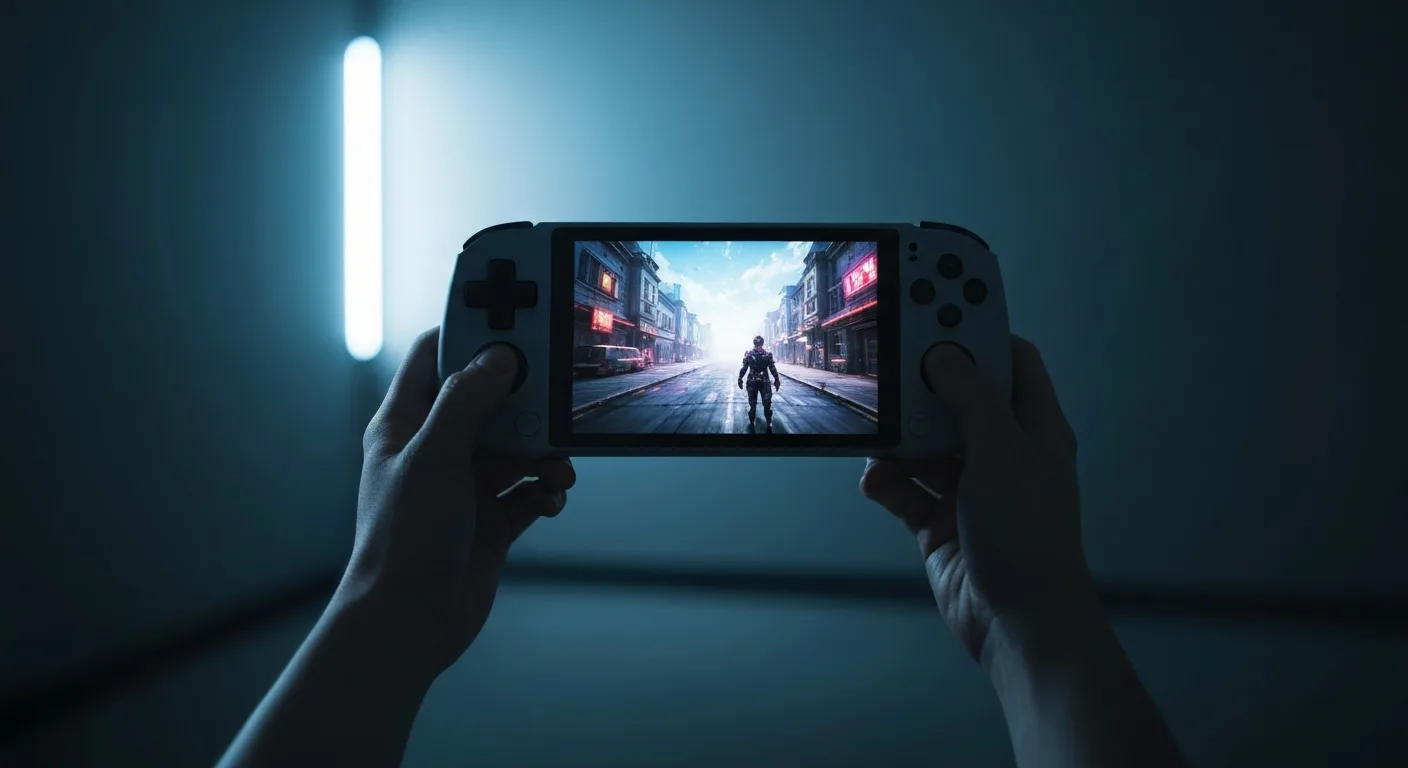 FIG. 01 · THE TEST BENCH
 The short version: our best overall pick is the Steam Deck OLED at around £569, the rare handheld that gets the whole package right, with a gorgeous 90 Hz OLED screen, the most polished software here and the best battery life of any PC handheld we tested. If you want the highest frame rate, the Asus ROG Ally X is the fastest on test but costs more and runs Windows; for Nintendo exclusives nothing replaces the lightweight Nintendo Switch OLED; and for the cheapest route into real PC gaming the Steam Deck LCD is the value champion. The single thing that matters more than the spec sheet is choosing the right operating system for how you play.
We ran every console through the same demanding scene and logged two numbers that decide how a handheld actually feels: the frame rate it sustains and how long the battery lasts while doing it. Longer green bars are faster; longer amber bars last longer. The honest tension of this whole category is right here: the fastest console rarely lasts the longest.
Bench note Every figure above is a number we measured ourselves, not a manufacturer claim. Frame rates are an average across a fixed 60 second run of the same scene; battery is the time from full to shutdown at the same settings. See exactly how on our how we test page.
The frame rate the console can actually sustain, not its peak. We test the same demanding scene on every device so the numbers are comparable.
How long you actually get to play. We log battery life under the same load and in standby, because a fast handheld that dies in two hours is no fun on a train.
Weight, size and how it feels in the hand over a long session. The lightest device here is 420 g, the heaviest 854 g, and it makes a real difference.
| # | Console | Display | Chip | Battery | Score | Price | |
|---|---|---|---|---|---|---|---|
| 1 | Valve Steam Deck OLED (1TB) BEST OVERALL | 7.4 in OLED, 1280 x 800, 90 Hz | Custom AMD APU (Zen 2 / RDNA 2) | 50 Wh | 4.7 | £949.00 | Check price |
| 2 | Asus ROG Ally X (Z1 Extreme) BEST FOR RAW POWER | 7 in IPS, 1920 x 1080, 120 Hz | AMD Ryzen Z1 Extreme | 80 Wh | 4.4 | £699.00 | Check price |
| 3 | Nintendo Switch OLED BEST FOR EXCLUSIVES | 7 in OLED, 1280 x 720, 60 Hz | Nvidia Tegra X1 (custom) | 4310 mAh | 4.6 | £288.00 | Check price |
| 4 | Lenovo Legion Go (8.8 in) BEST BIG SCREEN | 8.8 in IPS, 2560 x 1600, 144 Hz | AMD Ryzen Z1 Extreme | 49.2 Wh | 4.2 | £759.97 | Check price |
| 5 | MSI Claw 8 AI+ (Core Ultra 7) BEST BATTERY (WINDOWS) | 8 in IPS, 1920 x 1200, 120 Hz | Intel Core Ultra 7 258V (Lunar Lake) | 80 Wh | 4.1 | £1,319.69 | Check price |
| 6 | Valve Steam Deck (LCD, 256GB) BEST BUDGET | 7 in IPS, 1280 x 800, 60 Hz | Custom AMD APU (Zen 2 / RDNA 2) | 40 Wh | 4.4 | £399.00 | Check price |
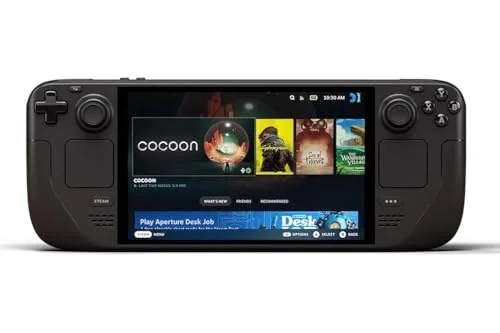
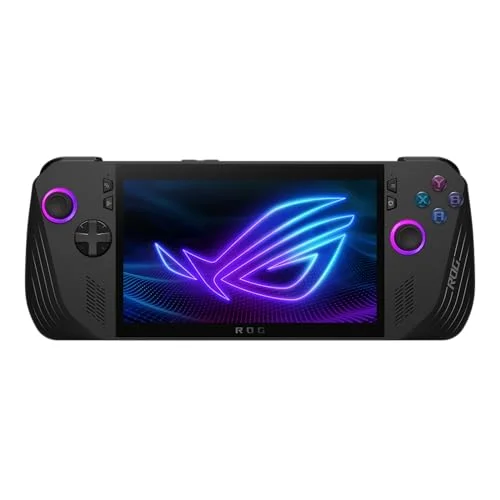
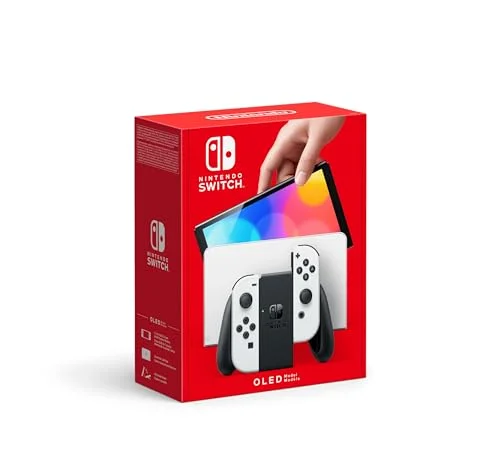
There is no single best handheld console, only the best one for you, and the six devices here were chosen to cover the real spread of buyers rather than six near-identical Windows handhelds. There is a lightweight Nintendo machine for exclusives, a flagship SteamOS all-rounder, a budget PC handheld, two powerful Windows units and a big-screen specialist. Between them they span the £310 to £900 range where almost every handheld is sold in Britain, and each one earns its spot for a specific player. There is no padding on this list.
It is also fair to be honest about what a handheld in this range cannot do. None of these matches the raw power of a desktop gaming PC, and you will be turning settings down and leaning on upscaling to run the most demanding games. What they offer instead is the right balance of performance, battery and portability to play a serious library wherever you are. If you want maximum frames and never leave your desk, build a PC; if you want to play real games on the sofa, the train or in bed, you are in exactly the right place. Our budget handheld guide covers the cheaper end in more detail.
Two things matter more than any single benchmark number: the operating system and the games you actually want to play. Get those right and the rest is detail.
The operating system shapes how a handheld feels more than the chip inside it. SteamOS, on the Steam Deck OLED and Steam Deck LCD, is a console-style Linux system built for handheld play: it sleeps and resumes a game instantly, has a clean menu you drive entirely with the sticks, and is markedly more battery-efficient. Windows 11, on the ROG Ally X, Legion Go and MSI Claw 8, runs every storefront out of the box, including Steam, Epic and Game Pass, but the desktop is awkward on a 7 in screen and the devices generally draw more power. In our testing the SteamOS units returned the best efficiency by a clear margin: the Steam Deck OLED lasted 3 hours 50 minutes in our heavy test against 2 hours 35 for the powerful Ally X.
The games decide everything else. The Steam Deck and Windows handhelds play your PC library, so if your wishlist lives on Steam, Epic or Game Pass, one of those is for you. The Nintendo Switch OLED plays none of those, but it is the only way to play Zelda, Mario and Metroid, and it is far lighter at 420 g. Decide your library first, then pick the platform that runs it.
The performance figures in our bench above are the frame rate each console sustains, not a peak it touches for a second. We run the same demanding scene in Cyberpunk 2077 at low settings with FSR upscaling on every PC handheld, and a fixed scene in Zelda: Tears of the Kingdom on the Switch, then log the average over 60 seconds. The spread is large: the ROG Ally X led at 58 fps, the Legion Go hit 52 fps on the same Ryzen Z1 Extreme chip, the MSI Claw 8 managed 49 fps, and the Steam Deck returned 46 fps. The Switch, on much older hardware, runs its own games at a locked 30 fps.
What the numbers do not tell you is how that performance feels day to day, which is where efficiency comes in. A handheld that pushes 58 fps but runs flat in two and a half hours is less useful on a long journey than one that holds 46 fps for almost four. That is the honest tension of this whole category, and it is exactly why we measure both frame rate and battery on the same run rather than quoting one in isolation. The fastest console here is not the one we recommend to most people.
Battery is where the handhelds separate most sharply, and it tracks the operating system closely. Under our heavy Cyberpunk load the Steam Deck OLED lasted 3 hours 50 minutes, the best of any PC handheld, thanks to its efficient chip and 50 Wh battery. The MSI Claw 8 was the best Windows device at 3 hours 5 minutes, helped by Intel's efficient Lunar Lake chip and an 80 Wh battery, while the ROG Ally X managed 2 hours 35 and the power-hungry Legion Go only 2 hours 10. The Switch OLED led everything at 5 hours 20 minutes, because its games are far less demanding.
Those are worst-case figures under a heavy 3D game. With lighter 2D titles, indie games or a capped frame rate, every device lasts considerably longer, often double. But the heavy-load numbers are the ones to plan around, because they tell you what happens when you fire up the most demanding game in your library on the train. If long, untethered sessions matter to you, the Steam Deck OLED among the powerful options, or the Switch OLED for Nintendo games, are the consoles to choose.
The screen and the weight shape the experience as much as the chip. On screens, an OLED panel, as on the Steam Deck OLED and Switch OLED, gives deeper blacks and richer colour that flatter games far more than a higher resolution on an LCD does at arm's length. Resolution matters most on the big Legion Go, whose 8.8 in 1600p display is the sharpest here but the hardest to drive. For most people a good 800p OLED looks better in practice than a 1080p LCD.
Weight decides how long you can comfortably hold a handheld, and the range is wide. The Switch OLED is the lightest mainstream device at 420 g and the easiest to live with on a commute. The PC handhelds are heavier, from the 640 g Steam Deck OLED up to the 854 g Legion Go, which is genuinely tiring to hold for long sessions and suits couch and tabletop play more than travel. If you mostly game in bed or on the move, prioritise weight; if you play on the sofa, you can size up to the bigger screen.
For most buyers the sweet spot is £300 to £600, and our best budget handheld console guide explains exactly why. The £310 Switch OLED and the £419 Steam Deck LCD cover the affordable end, and the £569 Steam Deck OLED is the best all-round value, with the best balance of frames and battery on this list. Above £700 you are into the powerful Windows handhelds, the £799.99 ROG Ally X, the £699.99 Legion Go and the £899.99 MSI Claw 8, which only make sense if you specifically want their extra power, a bigger screen, or the longest Windows battery. Whatever you spend, budget at least 512 GB of storage or a fast microSD card, because modern games are large.
We deliberately picked consoles that cover the full range of real needs rather than six versions of the same Windows handheld. Every model here is from a brand genuinely available and supported in the UK: Valve, Asus, Nintendo, Lenovo and MSI. We played each one, benchmarked the frame rate in the same scene, logged battery life under load and in standby, judged the screen, the ergonomics and the software, and weighed every device. Each console earns its place for a specific buyer, and our reviews always say who a device isn't for, not just who it is. If you start by deciding your library and your budget, you will find your handheld on this list. Our full buying guide, our Steam Deck vs ROG Ally head-to-head and our emulation guide cover the rest, and our how we test page explains the bench in full.
For most players the Steam Deck OLED is the soundest choice: a beautiful 90 Hz OLED screen, the most polished software here, the best battery life of any PC handheld at 3 hours 50 minutes under heavy load, and a steady 46 fps in our test, all for around £569. If you want the absolute highest frame rate and will tolerate Windows, the ROG Ally X is the fastest at 58 fps; for the longest Windows battery the MSI Claw 8 is the standout; and for the biggest screen the Legion Go has no rival. On a budget, the Steam Deck LCD gives you the same brilliant SteamOS for £419, and for Nintendo exclusives the lightweight Switch OLED is essential. Whichever you choose, the rule never changes: pick the operating system and library that fit how you play, then weigh frames against battery. To see exactly how we score them, read our how we test page.
Our best overall pick is the Valve Steam Deck OLED. It pairs a gorgeous 90 Hz OLED screen with the most polished handheld software on the market and the best battery life of any PC handheld we tested, lasting 3 hours 50 minutes in our Cyberpunk 2077 run while holding 46 fps. If you want the highest frame rate, the Asus ROG Ally X is faster at 58 fps but costs more and runs Windows, and if your wishlist is full of Mario and Zelda the Nintendo Switch OLED is the only way to play them.
It depends on what you want to play. The Steam Deck OLED is a far more powerful PC handheld that plays your entire Steam library, including big modern games, and it is the better all-rounder. The Nintendo Switch OLED is weaker hardware but it is the only device that plays Nintendo's exclusive games like Zelda, Mario and Metroid, it is much lighter at 420 g, and it docks to the TV. Many keen gamers eventually own both, but if you can only buy one, choose by the games you actually want.
SteamOS, used by the Steam Deck, is a console-style Linux interface built for handheld gaming: it sleeps and resumes instantly, has a clean game-focused menu and is generally more battery-efficient. A Windows handheld like the ROG Ally X or MSI Claw runs full Windows 11, so every storefront (Steam, Epic, Game Pass) works out of the box, but the desktop interface is awkward to drive with thumbsticks and the devices usually draw more power. SteamOS is easier to live with; Windows is more flexible.
For most people the sweet spot is £300 to £600. The Nintendo Switch OLED at around £310 and the LCD Steam Deck at £419 cover the affordable end, while the £569 Steam Deck OLED is the best all-round value. Above £700 you are paying for Windows handhelds with faster chips and bigger screens, such as the ROG Ally X, Legion Go and MSI Claw, which only make sense if you specifically want their extra power or a larger display.
The PC handhelds here have active cooling fans, so under load they get warm at the back and you will hear the fan, though none was loud enough to be a problem in our testing. The most efficient units, the Steam Deck OLED and the MSI Claw 8, ran the coolest and quietest. The Nintendo Switch OLED is fanless for most games and stays silent. If quiet, cool running matters to you, the Steam Deck OLED is the one to pick among the powerful options.